

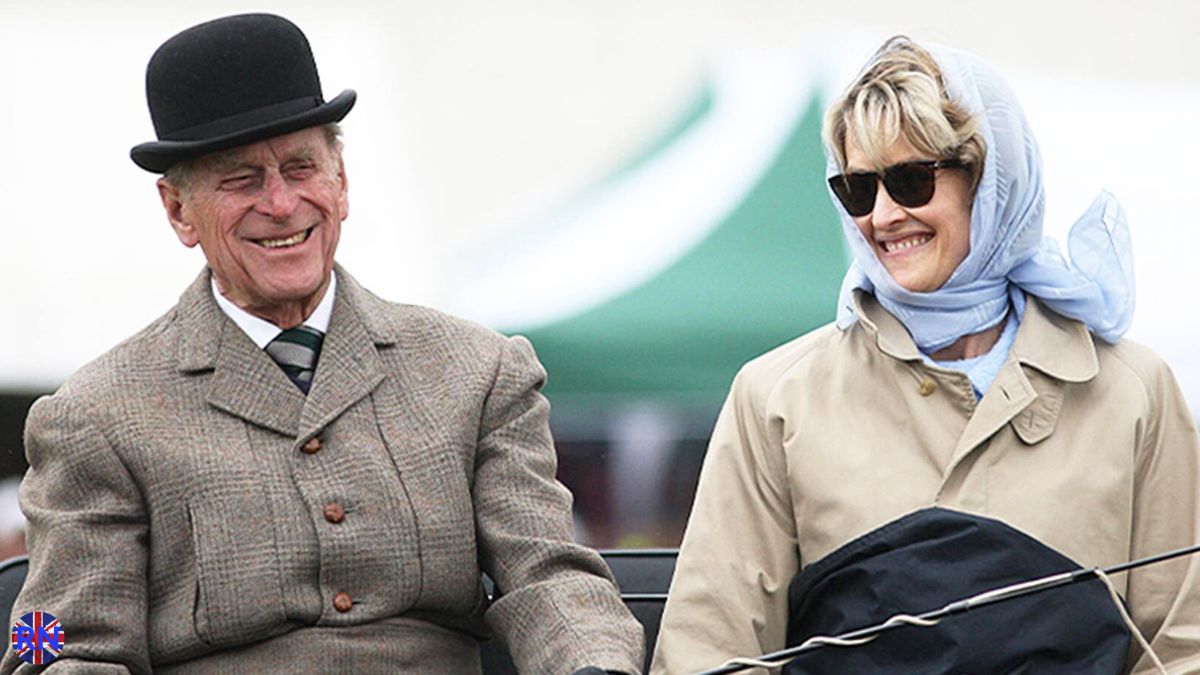
The name Penny Romsey carries a quiet significance within modern British royal history. It does not belong to a reigning monarch or a public figure seeking attention, yet it consistently appears at meaningful moments in the life of Prince Philip, Duke of Edinburgh. Romsey represents discretion, loyalty, and emotional closeness in an environment defined by protocol and tradition.
Her story is not one of ceremony or authority, but of presence. Through decades of friendship, shared experiences, and mutual trust, Penny Romsey became part of the royal inner world—respected without ever needing a formal role.
Who Penny Romsey Is Beyond the Title
Romsey was born Penelope Meredith Eastwood in 1953. Her upbringing reflected the values of Britain’s upper social circles: privacy, education, and restraint. These qualities later shaped her ability to move comfortably within aristocratic and royal environments without seeking prominence.
Through marriage to Norton Knatchbull, who held the courtesy title Lord Romsey before inheriting the Earldom of Mountbatten of Burma, she became known as Lady Penny Romsey. The name Penny Romsey, used informally, became the identifier most associated with her public appearances.
What distinguishes her is not rank, but longevity—she remained a constant presence during periods of personal change and emotional difficulty within the royal family.
Lady Penny Romsey and Her Place in British Aristocracy
As Lady Penny Romsey, she entered a world governed by tradition rather than celebrity. Aristocratic life emphasizes duty, continuity, and reputation. Within this structure, Penny Romsey earned respect through conduct rather than visibility.
Her role was never defined by speeches or patronages. Instead, it was shaped by relationships—particularly with Prince Philip—where trust outweighed formal titles. This form of influence is subtle but enduring.
Penny Romsey and Philip: A Bond Built on Understanding
The relationship between Penny Romsey and Philip developed over many years. It was rooted in shared interests, open conversation, and a mutual appreciation for honesty. Prince Philip valued directness and resilience—traits Romsey possessed in abundance.
Their bond deepened during periods of personal hardship. Penny Romsey experienced profound loss in her own life, which shaped her emotional perspective. That shared understanding of grief and endurance formed the foundation of their connection.
This relationship never displaced royal duty or marriage. It existed alongside them, defined by companionship rather than convention.
Penny Romsey at Philip’s Funeral: A Symbolic Presence
The public became acutely aware of Penny Romsey at Philip’s funeral in 2021. Her seating position during the service at St George’s Chapel was deliberate and meaningful. Royal ceremonies are carefully structured, and proximity reflects significance.
Her presence acknowledged a long-standing personal bond rather than a public role. It was a moment of quiet recognition—one that aligned perfectly with the nature of her relationship with the Duke of Edinburgh.
Penny Romsey and Sandringham Christmas Traditions
Spending Christmas at Sandringham is reserved for those within the royal family’s most trusted circle. Penny Romsey Sandringham Christmas appearances were not ceremonial invitations but personal ones.
Sandringham represents privacy, family continuity, and tradition. Penny Romsey’s inclusion signaled familiarity and trust built over years. It demonstrated that her presence was not symbolic, but genuinely valued.
Public Visibility Without Public Ambition
Penny Romsey has never sought attention, and this restraint has shaped how she is perceived. When she appears in public, it is almost always connected to royal milestones rather than personal initiatives.
Her reputation rests on consistency, emotional intelligence, and discretion. In an environment where scrutiny is constant, her ability to remain grounded has preserved both her privacy and her credibility.
Cultural Portrayals and Modern Interest
Recent dramatizations of royal life have brought renewed attention to Penny Romsey. These portrayals focus less on spectacle and more on emotional context—highlighting the importance of trusted relationships behind palace walls.
While dramatized accounts inevitably simplify reality, they reflect a broader truth: Penny Romsey mattered because she was present when presence mattered most.
The Enduring Legacy of Penny Romsey
The legacy of Penny Romsey is not marked by institutions or initiatives, but by human connection. She represents a form of influence that does not rely on authority, and a role that exists beyond official definitions.
Her story illustrates how loyalty and empathy shape history quietly, often unnoticed until moments of reflection bring them into focus.
Conclusion
Penny Romsey occupies a unique place in modern royal history. She was neither royal nor peripheral. Through trust, consistency, and emotional strength, she became part of Prince Philip’s private world and, by extension, part of the royal family’s lived experience.
Her story reminds us that significance is not always visible, and that some of the most enduring relationships leave no formal record—only lasting respect.
