

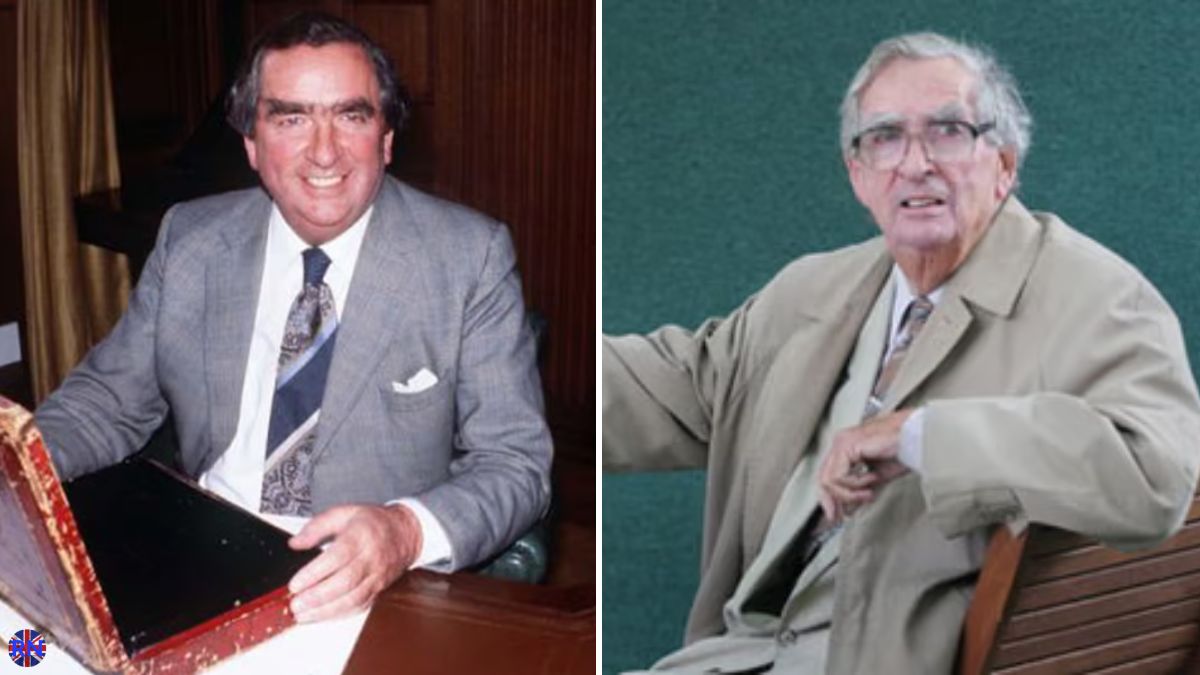
Dennis Healey, more accurately spelled Denis Healey, was one of the most recognizable British Labour politicians of the 20th century. A former Chancellor of the Exchequer and Defence Secretary, Healey spent four decades in Parliament and became a major figure in the political battles that shaped postwar Britain.
Born in 1917, Healey combined an impressive academic background with military service during the Second World War before entering Westminster politics. He served as an MP from 1952 until 1992, held senior Cabinet positions under Labour governments, became Deputy Leader of the Labour Party, and later entered the House of Lords.
His public image was distinctive. Healey was known for his intelligence, booming personality, famously prominent eyebrows and sharp political wit. Yet behind the recognizable public persona was a politician who spent much of his career dealing with difficult questions about Britain’s economy, defence policy, international relations and the future direction of the Labour movement.
Early Life and Family Background
Denis Winston Healey was born on August 30, 1917, in Mottingham, Kent, England. His father, Will Healey, was an engineer who later became principal of Keighley Technical College in Yorkshire. The family subsequently moved north, and Healey’s education helped establish the academic foundation for his later political career.
Healey attended Bradford Grammar School, where he developed a strong interest in literature and academic subjects. His abilities eventually earned him a scholarship to Oxford University.
At Balliol College, Oxford, he studied classics and philosophy and achieved a first-class degree. His time at Oxford was also politically formative. He became deeply involved in student politics and developed an interest in the ideological struggles taking place across Europe during the 1930s.
Healey’s political thinking was influenced strongly by the rise of fascism. He briefly joined the Communist Party while at university, later becoming firmly associated with the Labour movement and with the moderate, internationalist tradition within the party.
His Oxford years also introduced him to Edna May Edmunds, whom he would later marry. Their relationship became an important part of his private life for decades.
Denis Healey During the Second World War
The Second World War interrupted the normal path that Healey’s education might otherwise have taken.
He served in the British Army and was commissioned into the Royal Engineers. His wartime service included campaigns in North Africa and Italy, and he was involved in the Allied landings at Anzio. By the end of the war, he had risen to the rank of major.
The experience had a lasting influence on him.
Healey returned from the war with a stronger interest in international affairs and Britain’s role in the world. His wartime generation would later provide some of the most influential figures in British politics, and Healey became one of the prominent Labour politicians shaped by that experience.
He also became increasingly committed to the idea that Labour should combine social reform at home with a strong international and defence policy.
Entry Into British Politics
After the war, Healey became increasingly active in Labour politics.
His first attempt to enter Parliament came in the 1945 general election, when he contested Pudsey and Otley. He was unsuccessful, but he continued building his political career during the following years.
In 1952, Healey won a by-election and entered the House of Commons as the Labour MP for Leeds South East. He later represented Leeds East, a constituency he held until his retirement from the Commons in 1992. Parliamentary records show that he remained a Labour member throughout his Westminster career.
Healey quickly developed a reputation as an intelligent and forceful politician. He was particularly interested in foreign affairs, defence and economic policy, areas that would eventually lead him into senior government positions.
During the political divisions within Labour in the 1950s and later decades, he generally occupied the moderate wing of the party. He supported Hugh Gaitskell and was associated with Labour’s pro-Western and Atlanticist outlook.
Career as Defence Secretary
One of the most important stages of dennis healey political career began after Labour won the 1964 general election.
Prime Minister Harold Wilson appointed him Secretary of State for Defence. Healey remained in the role from 1964 until Labour lost power in 1970. Parliament records his tenure as running from October 16, 1964, to June 19, 1970.
Healey inherited a complicated defence portfolio at a time when Britain was reassessing its position in the world.
The country was no longer the global power it had been before the Second World War, while defence spending remained substantial. Healey therefore faced the difficult task of balancing military commitments with Britain’s declining economic resources.
His tenure included major decisions concerning Britain’s armed forces, overseas commitments and defence spending. He also maintained Britain’s close relationship with the United States while the Vietnam War was becoming increasingly controversial.
Healey’s years as Defence Secretary helped establish his reputation as a serious Cabinet politician rather than simply a parliamentary debater.
Chancellor of the Exchequer
When Labour returned to government in 1974, Healey moved to another demanding Cabinet position: Chancellor of the Exchequer.
He served as Chancellor from March 25, 1974, until May 5, 1979, first under Harold Wilson and subsequently under James Callaghan.
His time at the Treasury coincided with one of the most difficult economic periods in modern British history.
Britain faced high inflation, industrial unrest, weak economic growth and pressure on the pound. The international oil crisis had also created enormous economic problems for countries around the world.
Healey’s approach evolved during these years. Early Labour economic policy involved substantial public spending commitments, but worsening economic conditions forced the government to reconsider its position.
One of the defining moments came in 1976, when the British government sought financial assistance from the International Monetary Fund. The resulting agreement involved conditions concerning public spending and economic management. The episode became an important symbol of the economic difficulties facing Britain during the 1970s.
Healey’s period as Chancellor remains controversial. Supporters regarded him as a politician who confronted an exceptionally difficult economic inheritance, while critics argued that some Labour policies contributed to Britain’s financial problems.
Whatever the interpretation, his tenure placed him at the center of Britain’s economic crisis and made him one of the most important political figures of the decade.
Labour Leadership Battles
Healey’s ambitions extended beyond Cabinet government.
After Harold Wilson resigned as Labour leader and Prime Minister in 1976, Healey contested the Labour leadership election. He lost to James Callaghan, who subsequently retained him as Chancellor.
Four years later, Healey again stood for the leadership.
In the 1980 Labour leadership contest, he narrowly lost to Michael Foot. Foot then selected Healey as Deputy Leader, creating an unusual relationship between two politicians who represented very different traditions within the Labour Party.
Healey’s position became even more important during the party’s internal battles in the early 1980s. Tony Benn challenged him for the deputy leadership, producing one of the most closely fought contests in Labour’s history.
Healey survived the challenge by a very small margin. Parliament records his service as Deputy Leader from November 1980 until June 1983.
The episode demonstrated both his strength within the party and the intensity of Labour’s ideological divisions during that period.
Later Parliamentary Career
After Labour’s heavy defeat in the 1983 general election, Healey stepped down as Deputy Leader but remained an influential figure.
He continued serving in the Shadow Cabinet until 1987 and remained a prominent Labour voice in Parliament. His political experience gave him a respected position even when he was no longer at the center of day-to-day party leadership.
Healey eventually retired from the House of Commons at the 1992 general election after approximately four decades as an MP.
Soon afterward, he entered the House of Lords as Baron Healey. He remained active in the upper chamber until his death in 2015.
His parliamentary career therefore stretched from the early postwar years into the modern era, covering an extraordinary period of political and social change in Britain.
Personal Life and Marriage
Denis Healey married Edna May Edmunds on December 21, 1945. The couple had met while studying at Oxford, and their marriage lasted for almost 65 years until Edna’s death in 2010.
Edna Healey developed a career of her own as a teacher, lecturer, author and filmmaker. She was particularly interested in literature and education and wrote the book Wives of Fame, which examined the lives of women married to prominent men.
The couple had three children, including broadcaster and writer Tim Healey. They spent much of their later life in Alfriston, East Sussex.
Healey’s private interests extended beyond politics. He was an enthusiastic amateur photographer and enjoyed music, painting and reading crime fiction. He was also known to play the piano at social and public occasions.
These interests contributed to the more relaxed side of a politician who was often portrayed as combative and formidable in Parliament.
Denis Healey’s Appearance and Public Image
Healey became almost as recognizable for his appearance as for his political career.
His thick, bushy eyebrows became a defining feature, and his expressive face made him a natural subject for political cartoons and television impressions.
He was also known for his distinctive voice, humor and willingness to engage in verbal exchanges. His personality helped him remain recognizable to the wider British public even after leaving frontline politics.
The phrase “Healeyisms” became associated with his colorful turns of phrase. His ability to combine political seriousness with humor made him an unusually memorable figure in British public life.
Rather than maintaining the detached image sometimes associated with senior politicians, Healey cultivated a more personal and approachable public persona.
Denis Healey and His Political Legacy
Assessing dennis healey legacy requires looking at several different parts of his career.
As Defence Secretary, he played a major role in Britain’s reassessment of its military commitments during the 1960s. As Chancellor, he confronted severe economic pressures that included inflation, currency instability and the 1970s energy crisis.
His political career also reflected the long-running ideological struggle within the Labour Party.
Healey represented a Labour tradition that supported public services and social reform while also emphasizing economic discipline, Britain’s relationship with the United States and the importance of national defence.
That position sometimes placed him at odds with the party’s left wing, particularly during the battles surrounding Tony Benn in the early 1980s.
His reputation has consequently remained more complicated than that of a politician who can easily be placed into one ideological category.
Net Worth
There is no sufficiently reliable public record establishing a definitive personal net worth for dennis healey.
Although some websites have published numerical estimates, those figures are generally difficult to verify through authoritative financial records. They should therefore not be presented as confirmed facts.
Healey’s income came primarily from his long political career, parliamentary service and later activities as a member of the House of Lords, along with writing and other professional work.
For that reason, a specific net-worth figure would be speculative and is best excluded.
Interesting Facts About Denis Healey
- He was born in 1917: Healey belonged to the generation whose formative years were shaped by the First World War and the political upheaval that followed.
- He studied at Oxford: He attended Balliol College and achieved a first-class degree in classics and philosophy.
- He served during World War II: His military career included service in North Africa and Italy, including the Anzio campaign.
- He spent 40 years in the Commons: Healey entered Parliament in 1952 and retired as an MP in 1992.
- He held two major Cabinet positions: He served as Defence Secretary and later Chancellor of the Exchequer.
- He became a Labour deputy leader: Healey served as Deputy Leader from 1980 to 1983.
- His eyebrows became part of his public identity: His distinctive appearance and humorous personality made him one of Britain’s most recognizable politicians.
FAQs
Who was Denis Healey?
Denis Healey was a British Labour politician who served as Defence Secretary from 1964 to 1970 and Chancellor of the Exchequer from 1974 to 1979. He was also Deputy Leader of the Labour Party and served as an MP from 1952 to 1992.
Why is Dennis Healey sometimes spelled with two “n”s?
The correct spelling of the famous British politician’s first name is Denis Healey, with one “n” in Denis. “Dennis Healey” is a common search variation, but it refers to the same politician in many search queries.
When was Denis Healey Chancellor of the Exchequer?
Denis Healey served as Chancellor of the Exchequer from March 1974 to May 1979. He held the position during a particularly difficult period for the British economy.
Was Denis Healey married?
Yes. He married Edna May Edmunds in December 1945. They remained married until Edna’s death in 2010 and had three children.
How long was Denis Healey an MP?
Healey served in the House of Commons from 1952 until 1992, representing Leeds constituencies for most of his parliamentary career.
When did Denis Healey die?
Denis Healey died on October 3, 2015, aged 98. He remained a member of the House of Lords until his death.
What was Denis Healey known for?
He was known for his senior roles in Labour governments, his service as Defence Secretary and Chancellor, his involvement in Labour leadership contests, and his distinctive public personality.
Conclusion
Dennis Healey, correctly known as Denis Healey, left a substantial mark on British political history. His career crossed some of the country’s most turbulent decades, from the aftermath of the Second World War to the economic crises of the 1970s and the ideological battles within Labour during the 1980s.
His experience as a wartime soldier, academic, Defence Secretary, Chancellor and senior Labour politician gave him a breadth of experience few contemporaries could match. He was also an unusually recognizable public figure, combining political seriousness with humor, strong opinions and a memorable personality.
Healey died in 2015 at the age of 98, but his role in postwar British politics remains significant. His career offers a window into the changing Labour Party, Britain’s changing place in the world and the economic challenges that defined much of the second half of the 20th century.
